(trigger warning)
I have been pondering rape fear lately. I have pondered the way rape victims seem to be blamed for being promiscuous, in the wrong place, asking for it, or downright stupid. Shouldn't the blame, again, be squarely on the shoulders of...oh I don't know, the perpetrators? I have realized that my beef with victim-blaming in sexual abuse situations like my own, very closely coincides with how many rape victims feel and are treated. I want to speak out against victim-blaming. Victims: it is NOT your fault. Predators: it IS your fault. I do not care how many people have told you that it is understandable that you would be tempted to rape someone. You are to blame, solely.
I love reading Shakesville. It is my favorite feminist/equal rights/progressive blog to read. Melissa McEwan wrote today about rape and it resonated with me so strongly that I had to link to it from here. Enjoy.
Tuesday, August 04, 2009


Friday, July 31, 2009
Another Hippie/Green/Organic Link (in the same fashion as the last one: short and easy to remember)
If you read my last post and found it helpful to know about the Clean 15 and the Dirty Dozen, then you might also like this simple 3 part list to reduce chemical exposure in your daily life:
1. Avoid pesticides and how
2. Avoid BPA and PFC's
3. Avoid growth hormones and antibiotics.
(continued in full below, or click on the yellow link)
..............................................................................................................................................
1. Avoid pesticides and how
2. Avoid BPA and PFC's
3. Avoid growth hormones and antibiotics.
(continued in full below, or click on the yellow link)
..............................................................................................................................................
Healthy Home Tips (on the Environmental Working Group Website)
1. Why should you avoid pesticides?
Years of research have shown different pesticides to be associated with a variety of health problems, including:
- Cancer
- Hormone disruption
- Abnormal brain and nervous system development
Young children and pregnant women are especially at risk. Pesticides are unique among chemicals released into the environment because they are toxic by design. Their sole purpose is to kill living or“pests” - insects, plants and fungi.
How to avoid pesticides on your food
- Buy organic when you can. Organic produce is grown without pesticides, so when you eat it you’re not also eating toxic chemicals. As it should be.
- Don’t use pesticides to grow your own food. More and more Americans have backyard and community gardens. Use natural techniques – not pesticides - to manage pests.
- When you can’t buy organic, buy less-contaminated conventional produce. Every year EWG ranks popular fruits and vegetables based on the amount of pesticide residues found on them. For example, apples and peaches top our “Dirty Dozen” list, so buy those organic, but sweet corn, peas and watermelon are all in the “Clean 15,” so you can feel better about buying those raised conventionally.
- Download the guide and the handy iPhone app at FoodNews.org. Donate and we'll send you a fridge magnet, too.
Buy fresh to minimize packaging
EWG recommends eating foods that have been processed as little as possible. Processing techniques detract from nutritional value, and chemicals from food packaging can leach into what you’re eating. For food packaging we recommend avoiding bisphenol A (BPA) and the Teflon and Scotchgard family of perfluorochemicals (PFCs).
What is BPA and why should you avoid it?
Bisphenol A, also known as BPA, is a synthetic estrogen used to harden polycarbonate plastics (like some baby and water bottles) and in the epoxy resin used can linings. It was found in the bodies of 93 percent of the Americans tested by the Centers for Disease Control. In laboratory tests trace BPA exposure been shown to disrupt the endocrine system and trigger a wide variety of disorders, including chromosomal and reproductive system abnormalities, cancer, cardiovascular system damage, adult-onset diabetes, obesity and resistance to chemotherapy.
As with many toxic chemicals, infants and young children are at the greatest risk of harm because their bodies are still developing. The National Toxicology Program has expressed concern that children’s exposure to BPA may lead to problems with brain and reproductive system development and behavior.
Limit your exposure to BPA from canned foods and plastic containers
- Canned foods. Almost all canned foods (including canning jars) sold in the U.S. have a BPA-based epoxy liner that can leach BPA into the food inside. Pregnant women and young children, especially, should limit their consumption of canned foods to avoid BPA. Here’s how:
- If you’re feeding your baby infant formula, use powdered formula because it has the least BPA. If you’re set on liquid formula, choose a brand sold in plastic and avoid ready-to-eat formula, which has the highest levels. Read more from EWG on safely feeding your baby.
- Buy fresh or frozen vegetables instead of canned.
- For canned veggies and fruits, choose glass bottles where available; the lids may contain BPA but less than cans.
- For canned beans, consider choosing Eden Foods brand because the cans are BPA-free. Or soak and cook dried beans – it’s a little more work but also less expensive.
- In a pinch, rinsing canned fruit or vegetables may reduce the amount of BPA you ingest.
- Make a special effort to avoid canned prepared foods like pastas and soups. We have found that they tend to have higher levels of BPA.
- Simple precautions can minimize exposure to BPA and other chemicals that leach from plastic containers and water bottles:
- Use glass or a BPA-free plastic baby bottles.
- Avoid polycarbonate containers (marked with a #7 or ‘PC’), especially for children’s food and drinks.
- We recommend the use of glass over plastics, but when you have no choice, plastics marked with a #1, 2, 4, and 5 don’t contain BPA and are generally safer for food.
- Don’t microwave plastics or fill them with hot liquids.
- Wash plastics on the top shelf of the dishwasher, where the water is cooler, or by hand.
- Avoid old, scratched water bottles.
- Use stainless water bottles without plastic linings.
What are PFCs and why should you avoid them?
PFCs, short for perfluorochemicals, belong to the family of chemicals that includes Teflon and Scotchgard. They are used to coat carpets, clothes, furniture, and food packaging, among other things. They persist in the environment and the human body and have been associated with lower birth weight for babies, cancer, infertility, elevated cholesterol and liver problems.
How do PFCs get into your food?
PFCs are used to coat food packaging, particularly those made for greasy foods. Research has shown that the chemicals can leach into what’s inside – your food.
Limit your exposure
- Avoid non-stick pans and kitchen utensils. When overheated, they can release toxic particles and chemicals in gas form. Opt for stainless steel or cast iron instead.
- Cut back on greasy packaged and fast foods. You might find PFC’s in pizza boxes, fast foods wrappings, microwave popcorn bags, muffin and pastry bags, butter boxes, and hash brown and French fry bags.
- Pop popcorn the old-fashioned way - on the stovetop or with an air popper. You can also microwave popcorn in a brown paper lunch bag.
Under federal law, antibiotics and growth hormones are prohibited in organic meat and dairy products. We recommend organic dairy, meat and other products from Organic Valley Family of Farms, a cooperative of more than 1,300 certified organic farmers in more than 30 states. We're also fans of Stoneyfield Farm organic yogurt.

Tuesday, July 21, 2009
As Requested (by some of you). For others, here you go anyway.
I have constantly expressed my disgust with pesticides and all manner of food additives and alterations. I have heard some of you say "Hey if there's a comprehensive list, I'll take it!" Well, there is one (and it's been around for awhile but I have kept forgetting to post it here!). Thanks to my friend S for reminding me of it in an email this morning.
The Environmental Working Group tested produce for pesticide residues and put out these two lists: The Clean 15 and The Dirty Dozen.
The Clean 15 (or: Lowest in pesticides or: What you can buy conventionally/non-organically grown)
The Environmental Working Group tested produce for pesticide residues and put out these two lists: The Clean 15 and The Dirty Dozen.
The Clean 15 (or: Lowest in pesticides or: What you can buy conventionally/non-organically grown)
- Onion
- Avocado
- Sweet Corn
- Pineapple
- Mango
- Asparagus
- Sweet Peas
- Kiwi
- Cabbage
- Eggplant
- Papaya
- Watermelon
- Broccoli
- Tomato
- Sweet Potato
- Peach
- Apple
- Bell Pepper
- Celery
- Nectarine
- Strawberries
- Cherries
- Kale
- Lettuce
- Grapes (imported)
- Carrot
- Pear
Monday, July 20, 2009
Eventful
M decided to brave the scariness and come with me to Harry Potter. I screened it first by myself and thought he could just close his eyes at the scary parts if I warned him beforehand. It went well. The hardest part was getting him to hold still during a 2 1/2 hour movie. But alas, E would not eat for R at home. So around the 2 hour mark we had to go home anyways before the majority of the eye-closing scariness ensued.
M was a little miffed that he did not get to see the scary monsters in the water trying to pull Harry Potter down. Brave child. I was still happy to go before ending though. M was ready to get the wiggles out anyway. When we got home E was pretty proud of himself to resist a bottle from dad. He was getting played with and was giggling to his little heart's content. Stinker! But he knew when he saw mom that I meant business. He drank that sucker in 4 minutes flat. Sheesh.
In other news, M has finally managed to split his chin open in just the right spot to require stitches. He was looking at his fish, Annie. Annie is an ornery little malawi fish (I think) so we had to separate her from the others she was pecking to death. As M watched her in the bowl he knocked her onto the floor and then fell himself, hitting his chin on the counter on the way down. R and I saw the whole thing, grabbing the fish and filling the bowl back up with water and then checking M's chin and seeing the split. The cut is not that big, but it definitely needed stitches from the look of it. Fortunately, M thinks bandaids are magical, so he stopped crying when we got one onto his chin.
At Urgent Care they put numbing lotion on it for 5 minutes first, complete with a big stack of gauze and a long piece of tape. We joked about M's beard and that got him nice and distracted enough to enjoy the entire visit. When he heard that he was going to get glued, there was this little twinkle in his eye. M clearly thought that was pretty awesome. So once it was numb they glued it shut, put a sticky tape-X over it, and then a big ol' bandage over that. My little daredevil.
M was a little miffed that he did not get to see the scary monsters in the water trying to pull Harry Potter down. Brave child. I was still happy to go before ending though. M was ready to get the wiggles out anyway. When we got home E was pretty proud of himself to resist a bottle from dad. He was getting played with and was giggling to his little heart's content. Stinker! But he knew when he saw mom that I meant business. He drank that sucker in 4 minutes flat. Sheesh.
In other news, M has finally managed to split his chin open in just the right spot to require stitches. He was looking at his fish, Annie. Annie is an ornery little malawi fish (I think) so we had to separate her from the others she was pecking to death. As M watched her in the bowl he knocked her onto the floor and then fell himself, hitting his chin on the counter on the way down. R and I saw the whole thing, grabbing the fish and filling the bowl back up with water and then checking M's chin and seeing the split. The cut is not that big, but it definitely needed stitches from the look of it. Fortunately, M thinks bandaids are magical, so he stopped crying when we got one onto his chin.
At Urgent Care they put numbing lotion on it for 5 minutes first, complete with a big stack of gauze and a long piece of tape. We joked about M's beard and that got him nice and distracted enough to enjoy the entire visit. When he heard that he was going to get glued, there was this little twinkle in his eye. M clearly thought that was pretty awesome. So once it was numb they glued it shut, put a sticky tape-X over it, and then a big ol' bandage over that. My little daredevil.

Tuesday, July 14, 2009
Things M says (Part Eight)
While driving in the car to Trader Joe's (which is, BTW, my favorite place) and listening to an old CD by Red Grammar that I listened to when I was a girl, M says, "Wait a sec Mom, turn the music down, you gotta hear dis!"
And you know, I don't even remember what he said next. "Dis"!
And you know, I don't even remember what he said next. "Dis"!
Monday, July 13, 2009
Things M says (Part Seven)
On M's birthday to Grandma in an uncoached response to the question "How is being 4 different than being 3: "Well, 4-year-olds don't throw fits." Score!
E's Palate Recovery
E is doing pretty well, considering it has only been one week since he had palate reconstruction surgery. He has not recovered as readily as he did with lip surgery, but he improves every day. On Thursday we go in to have the 10 day checkup.
It has been tricky keeping up with all his physical therapy and chiropractic appointments for his torticollis, but as of this morning we are back on track. He is well enough to do all the stretches and tummy time at home, and to get to all his therapies this week. We lost a little momentum (his neck looks more crooked again), but I am determined to get it back. He also gets a preliminary helmet appointment this week. In the words of Thom Yorke "It's just like, spinniiiiiing plaaaates."

E getting one more chomp in before surgery.

Standing up in his baby hospital gown that says "tiny tired tiger" all over it.

In recovery right after coming out of anesthesia. It was not nearly as shocking as how he looked last time. All the stitches are inside, he is not as swollen, and he does not sound as different.

The face he has been making the most since surgery. A cross between "I am in pain", "I am kinda bored" and "Are you seriously still making me do tummy time?!"

Um, I want that camera. Seriously, give it to me.

Standing up in his baby hospital gown that says "tiny tired tiger" all over it.

In recovery right after coming out of anesthesia. It was not nearly as shocking as how he looked last time. All the stitches are inside, he is not as swollen, and he does not sound as different.

The face he has been making the most since surgery. A cross between "I am in pain", "I am kinda bored" and "Are you seriously still making me do tummy time?!"

Um, I want that camera. Seriously, give it to me.
M's Birthday. He's 4!
Well, M had a great birthday in spite of the fact that I was with E at the hospital for half of it. He spent the night at Grandma's, helped make his cake in the shape of a Golden Snitch that morning (complete with white frosting wings), got to eat cupcakes and Mexican food for dinner, had a visit from the Birthday Fairy after I got home and he woke up from his nap, and got to open a pile of presents when Daddy got home from work.
Hands down the favorite toy: Marbulous. He has played with that plastic marble run for at least 2-3 hours per day since his birthday. Oh, how I love that toy! I love that little man, getting so big and tall. For the record he is very into Wall-e, Harry Potter, Wipeout, Trouble, puzzles, butterflies, "swimming" with his stuffed water animals, playing his piano and dancing, and generally running around like a hyper little boy. We always joke that he's our little raccoon. Only it's kind of not a joke. :)
 Two squash M grew himself in the garden.
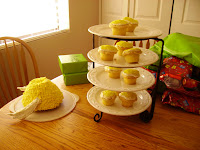 The birthday spoils.
Hands down the favorite toy: Marbulous. He has played with that plastic marble run for at least 2-3 hours per day since his birthday. Oh, how I love that toy! I love that little man, getting so big and tall. For the record he is very into Wall-e, Harry Potter, Wipeout, Trouble, puzzles, butterflies, "swimming" with his stuffed water animals, playing his piano and dancing, and generally running around like a hyper little boy. We always joke that he's our little raccoon. Only it's kind of not a joke. :)
 Two squash M grew himself in the garden.
 The birthday spoils.
Wednesday, July 08, 2009
Guest Post on The Exponent
I have made my Bloggernacle debut! Today I was able to provide a guest post on The Exponent blog. I have crossposted it here, but you should really check it out on the other site in case the comments get going. Plus, I love that blog. I am lucky to have a voice there.
How Well Does the Church Handle Abuse?
It took me until I was 18 and had moved out of my house to finally wander my way into the Counseling Center at BYU. I was having trouble in school, trouble sleeping, general anxiety. There began my awakening to what I was. I was abused as a child. I finally spoke the words aloud. I was broken. I was a victim.
The first time I told someone about my sexual abuse it was to my therapist at BYU. I was 19 by then. Through therapy I gradually put names on the abuse: physical, emotional, sexual, and spiritual. The sexual abuse took the forefront. I look back now and am shocked that my therapist did not insist on calling the police or a social worker when I told her. I was convinced that I was the only victim. But she knew that I had younger siblings still living at home. She knew that my father was the perpetrator. She knew that statistically it had probably happened to more of my siblings. I wish she had done something. Admitting that I came from an abusive family was so new to me at the time. I did not feel comfortable navigating those waters. I definitely did not have the guts to blow the whistle on my father. I did not even know that I should have blown the whistle on my father, that my siblings were in probable danger. A social worker or police officer should have been notified. My father should have been stopped.
That same year I told my bishop. His response was "How old were you when it happened?" I told him I was 8 years old. "Wasn't that a long time ago? I don't think you need to break up your family over this when you can deal with it through therapy." Then he asked "How old are your other siblings?" I told him I was the oldest of five and four of us were female. He asked whether I thought anyone else in the family had been abused. At that time, I honestly thought I was the only one, so I told him that. He restated that I did not need to tell anyone except my therapist. My younger sister was eleven at the time. At that point she had been abused for about three years.
I was sexually abused for about one year when I was in second grade and then it stopped. That was plenty. Once is enough to do all kinds of damage. In contrast, my younger sister endured 9 years of sexual abuse by the time my father was arrested. 9 YEARS. This kills me. It kills me not only because of the quantitative amount, but because it could have been stopped. I found out during the ninth year.
Once I learned of my sister's abuse I went to my bishop at the time, in Michigan. I was 25 by then, pregnant with my first child, and had several years of therapy under my belt. My bishop's response was so different. He told me he was bound by not only by Michigan law to call the police and report it, but also needed to call the Church hotline for legal advice on how to proceed. He advised that we call my parent's bishop and tell him what was going on. Surprisingly, that bishop was also very supportive of calling the police. Both bishops explained very gently that I was encouraged to be the one to call the local police in California and give a statement to an officer. They said that if I did not feel able, that they could give the statement for me, but it would be harder to prosecute my father and get my younger siblings into a safe environment.
I suspect that in the six intermediate years between talking to my BYU bishop and my Michigan bishop there was a change (shift?) in Church policy. I think they probably give bishops better instruction on what to do with abusers and victims. It sounds like bishops have Church leaders to call for advice. These are good steps, but I must be honest: it is not nearly enough. What about a hotline for the victims? What about bishops automatically providing therapy, instead of waiting for victims to ask? What about having stricter whistle-blowing policies, to protect further victims?
I cannot help but be cynical when the only time the Church seems to actively support calling the police is when children are still living at home and/or the abuser is still abusing. Abusers need to face the law and Church discipline, no matter if their victims live at home or not and no matter if they have "stopped". It sends a message to victims that they are inherently less important and undervalued when abusers do not have to pay for their crime. Victims have no choice but to pay for what happened to them.
I am an abuse survivor. Over the last four years since I learned of my sister I have been increasingly more open about it. So I find myself here at The Exponent reaching out to other women and men to tell a part of my story. For a more in personal account of my experiences, you can read my personal blog: kmillecam.blogspot.com. It is my priority there and in my life to openly discuss the effects of abuse. The truth will set us all free.
How Well Does the Church Handle Abuse?
It took me until I was 18 and had moved out of my house to finally wander my way into the Counseling Center at BYU. I was having trouble in school, trouble sleeping, general anxiety. There began my awakening to what I was. I was abused as a child. I finally spoke the words aloud. I was broken. I was a victim.
The first time I told someone about my sexual abuse it was to my therapist at BYU. I was 19 by then. Through therapy I gradually put names on the abuse: physical, emotional, sexual, and spiritual. The sexual abuse took the forefront. I look back now and am shocked that my therapist did not insist on calling the police or a social worker when I told her. I was convinced that I was the only victim. But she knew that I had younger siblings still living at home. She knew that my father was the perpetrator. She knew that statistically it had probably happened to more of my siblings. I wish she had done something. Admitting that I came from an abusive family was so new to me at the time. I did not feel comfortable navigating those waters. I definitely did not have the guts to blow the whistle on my father. I did not even know that I should have blown the whistle on my father, that my siblings were in probable danger. A social worker or police officer should have been notified. My father should have been stopped.
That same year I told my bishop. His response was "How old were you when it happened?" I told him I was 8 years old. "Wasn't that a long time ago? I don't think you need to break up your family over this when you can deal with it through therapy." Then he asked "How old are your other siblings?" I told him I was the oldest of five and four of us were female. He asked whether I thought anyone else in the family had been abused. At that time, I honestly thought I was the only one, so I told him that. He restated that I did not need to tell anyone except my therapist. My younger sister was eleven at the time. At that point she had been abused for about three years.
I was sexually abused for about one year when I was in second grade and then it stopped. That was plenty. Once is enough to do all kinds of damage. In contrast, my younger sister endured 9 years of sexual abuse by the time my father was arrested. 9 YEARS. This kills me. It kills me not only because of the quantitative amount, but because it could have been stopped. I found out during the ninth year.
Once I learned of my sister's abuse I went to my bishop at the time, in Michigan. I was 25 by then, pregnant with my first child, and had several years of therapy under my belt. My bishop's response was so different. He told me he was bound by not only by Michigan law to call the police and report it, but also needed to call the Church hotline for legal advice on how to proceed. He advised that we call my parent's bishop and tell him what was going on. Surprisingly, that bishop was also very supportive of calling the police. Both bishops explained very gently that I was encouraged to be the one to call the local police in California and give a statement to an officer. They said that if I did not feel able, that they could give the statement for me, but it would be harder to prosecute my father and get my younger siblings into a safe environment.
I suspect that in the six intermediate years between talking to my BYU bishop and my Michigan bishop there was a change (shift?) in Church policy. I think they probably give bishops better instruction on what to do with abusers and victims. It sounds like bishops have Church leaders to call for advice. These are good steps, but I must be honest: it is not nearly enough. What about a hotline for the victims? What about bishops automatically providing therapy, instead of waiting for victims to ask? What about having stricter whistle-blowing policies, to protect further victims?
I cannot help but be cynical when the only time the Church seems to actively support calling the police is when children are still living at home and/or the abuser is still abusing. Abusers need to face the law and Church discipline, no matter if their victims live at home or not and no matter if they have "stopped". It sends a message to victims that they are inherently less important and undervalued when abusers do not have to pay for their crime. Victims have no choice but to pay for what happened to them.
I am an abuse survivor. Over the last four years since I learned of my sister I have been increasingly more open about it. So I find myself here at The Exponent reaching out to other women and men to tell a part of my story. For a more in personal account of my experiences, you can read my personal blog: kmillecam.blogspot.com. It is my priority there and in my life to openly discuss the effects of abuse. The truth will set us all free.
Tuesday, July 07, 2009
We are home
And E is doing well. He is sleeping a lot and eating good amounts of milk, so I am not too worried about how sad he is in between those times. But it is still sad that he is sad :( I think he will get much better over the next few days. So far he has improved greatly since immediately after surgery. Thank you for writing, texting, and thinking. Love you guys.
Sunday, July 05, 2009
Guestposting
I have written a guest post that will appear on The Exponent blog in the next week. When it gets published there, I will crosspost it here so you all will know. I am pretty excited to have a voice there and to add to the discussion. I also feel like the subject matter is of great importance.
In the meantime, you should check out The Exponent. I know a few of the bloggers there and they are wonderful and have such interesting and pertinent things to say in the realm of feminism and Mormonism. Let me know what you think!
In the meantime, you should check out The Exponent. I know a few of the bloggers there and they are wonderful and have such interesting and pertinent things to say in the realm of feminism and Mormonism. Let me know what you think!
E's Palate Surgery
So tomorrow is the big day. Just knowing that folks are thinking of us is enough. If you like to pray or fast or devote some other kind of meditative time, that would just make my day to know that as well. I will post an update as soon as possible after surgery is over tomorrow late in the morning.
Friday, July 03, 2009
Do you think you can still play with an Exersaucer even if you are almost 4-years-old?

Well, it turns out you can.
Wednesday, July 01, 2009
Things M says (Part Six)
After coming home from taking R to the bus and realizing that I meant it when I said "You have to finish your mini-spooners when you get home, even if they're soggy", and scrunching up his face into a semi-fake sad face: "But Mom, I can't. It's all foggy."
Monday, June 29, 2009
Spiritual Abuse (Part Two)
I should clarify: the spiritual abuse characteristics list in my previous post were a summary taken from the Mormon Alliance website and based on the book by David Johnson and Jeff VanVonderen called The Subtle Power of Spiritual Abuse: Recognizing and Escaping Spiritual Manipulation and False Spiritual Authority Within the Church. I am purchasing it at some point to read entirely.
Sunday, June 28, 2009
Spiritual Abuse
Thanks to a friend for sending me to the Mormon Alliance website where I found this helpful description of spiritual abuse. I want to be specific: I am thinking of my home life in particular when I read this. Parsing out how this happens in wards is not something I want to tackle right now.
CHARACTERISTICS
In a spiritually abusive system, "the most important thing is how things look" (Johnson and VanVonderen 31). Johnson and VanVonderen tell of a pastoral ministries course offered at a Bible college where a young pastor-to-be was taught that his wife and children should address him in public as "Pastor." To maintain "pastoral dignity," he should always appear in his suit in public, even if it meant changing out of work clothes to run to the auto parts store. He should route the church telephone to his home and answer it "First Christian Church" to create the impression that he was constantly at church. When sitting on the platform at church, he must always wear proper socks and never cross his legs in a way that revealed the soles of his shoes. "Reveal your soul," he was told, "never your soles." Another instruction was about his voice: "When you ascend the platform, remember—you are the voice of God. Sound like it" (131).
Another characteristic of a spiritually abusive system is that its leaders require the place of honor. "Unhealthy, authoritarian leadership encourages people to place their pastors on pedestals" (Enroth 81). "It is our belief," write Johnson and VanVonderen, "that the less secure a leader is, the more important titles will be to him or her." Such leaders project the image of spirituality, require the recognition of people, and "point to themselves as the primary source of knowledge, direction, authority, and life" (134, 136).
Not only will spiritually abusive leaders demand honor, claim Johnson and VanVonderen, they may actually insist that others deny reality to maintain their authority: "Members have to deny any thought, opinion or feeling that is different than those of people in authority. Anything that has the potential to shame those in authority is ignored or denied"; in other words, "The system defines reality" (58).Spiritually abusive leaders invoke their position to enforce their decisions. "Because I’m the pastor, that’s why!" "Are you questioning my authority?" "Don’t be a troublemaker." "Submit to your elder." Such phrases are symptomatic of "false authority" (112). Johnson and VanVonderen identify two characteristics of false authority: first, the leaders take authority rather than receiving it from God. And second, their authority rests not upon wisdom, discernment, or truth, but solely upon their position or rank—they are to be obeyed because they are in charge.
Spiritually abusive systems encourage "misplaced loyalty": loyalty to Christ is transformed into loyalty to a leader or a church. Conversely, "disloyalty to or disagreement with the leadership is equated with disobeying God. Questioning leaders is equal to questioning God. After all, the leader is the authority, and authority is always right" (76). Enroth asserts that abusive leaders "consciously foster an unhealthy form of dependency, spiritually and interpersonally, by focusing on themes of submission, loyalty, and obedience to those in authority" (103).
This misplaced loyalty is cultivated by three methods. First, "leadership projects a ‘we alone are right’ mentality, which permeates the system." Second, leaders use "scare tactics" to bolster misplaced loyalty, perhaps telling departing members that "God is going to withdraw His Spirit from you and your family" or "God will destroy your business." And third, "you can be ‘exposed’ for asking too many questions, for disobeying unspoken rules, or for disagreeing with authority. People are made public examples to send a message to those who remain" (Johnson and VanVonderen 76-78).An extremely important characteristic of spiritually abusive systems is legalism. Legalism focuses on achieving righteousness through the performance of required behaviors and the avoidance of proscribed ones. People earn salvation through their human works. Johnson and VanVonderen warn against any spiritual system "in which the leaders or teachers add the performance of religious behaviors to the performance of Jesus on the cross as the means to find God’s approval" (36). In such a system, members must earn love and acceptance by obeying rules.
Johnson and VanVonderen tell of a Christian conference in which the attenders were given formulas for achieving "a nice, packaged, orderly Christian life." Those who successfully completed the course—mostly the naturally disciplined, strong-willed people—were permitted to attend an "advanced seminar." And the others? The speaker told the audience, "If you follow these principles and they don’t work, call me and tell me about it. You need to know, though, that you’ll be the first one for whom they didn’t" (44). Thus, anyone who questions the system runs an enormous risk of being labeled "unrighteous."
Legalism spawns a preoccupation with fault and blame. In the New Testament the purpose of confession is to receive forgiveness and cleansing; the spiritually abusive system demands confession "to know whom to shame—that is, whom to make feel so defective and humiliated that they won’t act that way anymore" (Johnson and VanVonderen 58).
Christians who trust the grace of Christ for salvation threaten a legalistic structure, since "living with Jesus as your only source of life and acceptance is a confrontation to those who seek God’s approval on the basis of their own religious behavior" (Johnson and VanVonderen 37).
Abusive leaders favor legalism for a number of reasons: busy and apparently righteous adherents make them look good; a legalistic system allows them to examine others instead of themselves; and they gain a sense of validation from the good works of their followers (Johnson and VanVonderen 37). Of course, despite such self-interested motives, these leaders’ demands are "cloaked in the language of being holy and helping others to live holy lives" (ibid).Spiritually abusive systems are characterized by deception, or what Johnson and VanVonderen call "double-talk." People are told "they are not spiritual enough to understand teachings or decisions of the leaders. The leaders sound pious enough, even spiritual. But we are left with the vague sense that something is missing. They will give you the ‘right’ answer, but rarely will you get the ‘real’ answer. Everything has a double meaning" (126). In conversation, receiving a straight answer requires a precisely phrased question.
Manipulation is the life-blood of abusive systems. The most powerful of the manipulative techniques is enforced silence, or what Johnson and VanVonderen call the "can’t-talk" rule: "If you speak about the problem out loud, you are the problem" (68). Those who speak out may be accused of being unloving, unspiritual, or un-Christian (ibid.). Enroth described one sect that, when confronted with its own wrong teachings, will "attack the character and life of the questioner by claiming that he has ‘sin in his life.’ Such terms as ‘prideful,’ ‘independent spirit,’ and ‘rebellious’ are used in answer to the inquirer" (117).
Scripture may even be invoked in the service of such abusive tactics. Thus, Hebrews 13:17, which counsels to "obey your leaders, and submit to them," is "stripped of its spirit and translated legalistically to mean, ‘Don’t think, don’t discern, don’t question, and don’t notice problems.’ If you do, you will be labeled as unsubmissive, unspiritual, and divisive" (Johnson and VanVonderen 171). Another frequently used scripture is Matthew 18:21-22, where the Lord tells Peter he must forgive "up to seventy times seven." This verse may be turned against an abuse victim with the courage to speak up. Instead of addressing the problem, the leader makes the member the problem: "What’s wrong with you that you can’t forgive?" (Johnson and VanVonderen 100). Thus, "truth is suppressed in the name of spirituality" and "the code of silence is enforced with God’s own Word" (Johnson and VanVonderen 94).
Another manipulative technique is the existence of unspoken rules. Johnson and VanVonderen observe that no one would ever say out loud, "You know we must never disagree with the pastor on his sermons—and if you do you will never be trusted and never be allowed to minister in any capacity in this church" (67). This is because "examining [the statement] in the light of mature dialogue would instantly reveal how illogical, unhealthy and anti-Christian [it is]" (ibid.). Yet the rule is subtly enforced.
Another manipulative technique is coding, the use of circuitous or euphemistic verbal formulations to avoid uncomfortable realities. Another is triangulation (they call it "triangling"), the use of intermediaries to deliver messages or directives to insulate the leader from the member’s response (Johnson and VanVonderen 57).Finally, spiritually abusive systems are secretive. "When you see people in a religious system being secretive—watch out. People don’t hide what is appropriate; they hide what is inappropriate" (Johnson and VanVonderen 78). Johnson and VanVonderen report the following comment from a "wounded" Christian: "Quite a number of us wanted more information about how church finances were being spent. We wanted to know if more money could go into direct ministries, benevolences, things like that. When I asked some questions at an elders’ meeting—boy did the room get icy. Later I was told to stop trying to create a faction in the church" (21). There are two reasons for the secrecy: Leaders feel that they must protect the image of the organization so outsiders will think well of it, thus making themselves "God’s ‘public relations’ agents"; and leaders condescend to members: They tell themselves, "People are not mature enough to handle truth" (78).
As a result, abusive systems abhor outside news media. According to Enroth, "Criticism, whether its source is Christian or secular, sincere or superficial, is always viewed by fringe churches as an ‘attack’" (164).
Friday, June 26, 2009
Women Be (Virtually) Shoppin'
This particular woman that is. I just had the most fun I have had in a long time finding various organic cotton items for E on amazon.com. Click on E's wish list on my sidebar if you would like to purchase said items for the cutest baby ever! I am especially enamored with:


This onezee saying "Hand Wash Only"

As well as this one with a dancing robot.

I also enjoy this rattle considering it will go in his mouth and is made of safe things.

And did you know they make yoga pants for babies?! Namaste.
As well as this one with a dancing robot.
Monday, June 22, 2009
Things M says (Part Five)
While playing with a butterfly, it says "butter! butter!"
While playing with a ladybug, "lay, lay, lay!"
While playing with a caterpillar, "cater, cater!"
Also, while playing with a pile of river rocks we bought at the craft store, he says "ahhh!" for each one jumping off a ledge. They are rocks playing Wipeout. I am pretty sure that in M's mind they are smacking into the big balls and then splashing down into the water. He also sometimes does the announcing, utilizing such phrases as "oh, that's gotta hurt!" and "oh man!"
While playing with a ladybug, "lay, lay, lay!"
While playing with a caterpillar, "cater, cater!"
Also, while playing with a pile of river rocks we bought at the craft store, he says "ahhh!" for each one jumping off a ledge. They are rocks playing Wipeout. I am pretty sure that in M's mind they are smacking into the big balls and then splashing down into the water. He also sometimes does the announcing, utilizing such phrases as "oh, that's gotta hurt!" and "oh man!"
Sunday, June 07, 2009
Residual Shame
I had an intense flashback to my abuse 2 days ago. It does not happen too often for which I am grateful, but when it does I try to keep my wits as best as possible. It was kinda funny/frustrating at first: M peed in the kitchen sink! He was going to wash his hands but when he turned the water on it made him have to go suddenly. So instead of having an accident he went in the sink. He was trying to be responsible, poor thing.
And how did I handle it? I said something to the effect of "that's gross/disgusting". I immediately saw how guilty he looked and how genuinely sorry he was. The most unnerving part was that he looked embarrassed. As I realized that he was trying solve a problem in an emergency and got yelled at anyway, I was yanked back to my childhood. I automatically worried that he was feeling like he was dirty or gross because of what I said. I was seized with fear thinking that I was putting my same issues that I dealt with right onto his shoulders to be repeated.
When I flashed back I remembered being shamed about my body growing up. There were times when I was shamed for eating because I was a chubby kid. There were times when I was shamed for not being clean and/or ladylike. This was usually a vicious cycle: I would forget to shower/brush teeth because I did not feel worthy of taking care of my body (probably from the sexual abuse), and then I would receive more shaming from my parents to be clean. I think it was for my mother's need to fit in as a perfect mother, so I did not stand out to other people as having problems. There were many times when I was very aware of how embarrassed my parents were to have such an awkward, overly sensitive, emotional child.
There was spiritual abuse from my mother: never have any desire to sin or you are "bad". And there was the emotional abuse from my mother: why are you kids acting like "A" when you know it makes me sad and depressed? The physical abuse from my father and mother: really angry spanking, throwing, yelling, sometimes slapping. And finally the sexual abuse at the hands of my father. I talk of all these abuses intertwining because that is the messy reality. I had a therapist say once that sexual abuse is symptom of many other problems. Clearly, this was the case in my family. The bottom line: I was ashamed of my body, among other things.
So after this M-and-sink incident, I sort of emotionally froze for the next day. It was a funny story, and I joked about it with people. I could even laugh about it. But in the back of my mind I kept regretting the way I handled it. I should have calmly explained instead of shaming M about his body. You see, M is very similar to me in many ways. I was a very sensitive child (as was R, so M never had a chance!), and would internalize many things. When I see M get embarrassed in his life, my knee jerk reaction is to address it and try to help him understand. I do not want him to carry unhealthy feelings about his body. He should have healthy understanding of how bodies work. All joking aside, peeing in the sink is not really that big of a deal. A simple explanation of how pee has germs and needs to go in the potty would have solved future incidents.
As I worked through my feelings that day I realized several things: I realized that regular childhood embarrassments are not the end of the world. M is experiencing the ups and downs of growing up, not abuse on all sides like I did. M just needs to know that I love him, and that I will try my best to help him. He will get embarrassed sometimes, and that is normal. Also, I was reminded that it is pointless to try and avoid embarrassment in life. It WILL happen. The best anyone can do is to work it out when it does happen. Finally, I realized that I should think and talk these things through. It is the only way to free yourself from them. It is painful, but necessary (for me.) So I eventually talked to R and admitted all the horrible scenes I was reliving. He reassured me that I am not my parents, and that M is not doomed to repeat my fate.
I tell this story to illustrate two things: (1) That the ripples of abuse can be very far-reaching, both into the future and deep into a survivor's psyche. Let this make abusers aware of the irreversible consequences of their actions. (2) Let this also make survivors aware of how important it is to be armed with tools from therapy. When I flashed back I knew to calmly face my demons until they had no power left. It took me a good full day, but I worked it out. I also talked to R and felt much better. You could also revisit a therapist if needed. I may make an appointment if I have any more flashbacks in the next few days.
And how did I handle it? I said something to the effect of "that's gross/disgusting". I immediately saw how guilty he looked and how genuinely sorry he was. The most unnerving part was that he looked embarrassed. As I realized that he was trying solve a problem in an emergency and got yelled at anyway, I was yanked back to my childhood. I automatically worried that he was feeling like he was dirty or gross because of what I said. I was seized with fear thinking that I was putting my same issues that I dealt with right onto his shoulders to be repeated.
When I flashed back I remembered being shamed about my body growing up. There were times when I was shamed for eating because I was a chubby kid. There were times when I was shamed for not being clean and/or ladylike. This was usually a vicious cycle: I would forget to shower/brush teeth because I did not feel worthy of taking care of my body (probably from the sexual abuse), and then I would receive more shaming from my parents to be clean. I think it was for my mother's need to fit in as a perfect mother, so I did not stand out to other people as having problems. There were many times when I was very aware of how embarrassed my parents were to have such an awkward, overly sensitive, emotional child.
There was spiritual abuse from my mother: never have any desire to sin or you are "bad". And there was the emotional abuse from my mother: why are you kids acting like "A" when you know it makes me sad and depressed? The physical abuse from my father and mother: really angry spanking, throwing, yelling, sometimes slapping. And finally the sexual abuse at the hands of my father. I talk of all these abuses intertwining because that is the messy reality. I had a therapist say once that sexual abuse is symptom of many other problems. Clearly, this was the case in my family. The bottom line: I was ashamed of my body, among other things.
So after this M-and-sink incident, I sort of emotionally froze for the next day. It was a funny story, and I joked about it with people. I could even laugh about it. But in the back of my mind I kept regretting the way I handled it. I should have calmly explained instead of shaming M about his body. You see, M is very similar to me in many ways. I was a very sensitive child (as was R, so M never had a chance!), and would internalize many things. When I see M get embarrassed in his life, my knee jerk reaction is to address it and try to help him understand. I do not want him to carry unhealthy feelings about his body. He should have healthy understanding of how bodies work. All joking aside, peeing in the sink is not really that big of a deal. A simple explanation of how pee has germs and needs to go in the potty would have solved future incidents.
As I worked through my feelings that day I realized several things: I realized that regular childhood embarrassments are not the end of the world. M is experiencing the ups and downs of growing up, not abuse on all sides like I did. M just needs to know that I love him, and that I will try my best to help him. He will get embarrassed sometimes, and that is normal. Also, I was reminded that it is pointless to try and avoid embarrassment in life. It WILL happen. The best anyone can do is to work it out when it does happen. Finally, I realized that I should think and talk these things through. It is the only way to free yourself from them. It is painful, but necessary (for me.) So I eventually talked to R and admitted all the horrible scenes I was reliving. He reassured me that I am not my parents, and that M is not doomed to repeat my fate.
I tell this story to illustrate two things: (1) That the ripples of abuse can be very far-reaching, both into the future and deep into a survivor's psyche. Let this make abusers aware of the irreversible consequences of their actions. (2) Let this also make survivors aware of how important it is to be armed with tools from therapy. When I flashed back I knew to calmly face my demons until they had no power left. It took me a good full day, but I worked it out. I also talked to R and felt much better. You could also revisit a therapist if needed. I may make an appointment if I have any more flashbacks in the next few days.
Thursday, June 04, 2009
Like I said yesterday...
The folks at Coca-Cola and Del Monte are a-scheming their way into fooling/scaring us with BPA nonsense. See Enviroblog here and the actual minutes from the meeting here. Un-freakin-believable.
RANT (just barely devoid of colorful expletives): Did you see on the Enviroblog link that Del Monte is up in arms about BPA legislation because the inside of virtually every can of canned food is lined with a "BPA-rich epoxy coating"? I think I am going to be sick. Now I will have to start canning all my own food. Crap. Fortunately I have already tried to choose glass jars when I can while buying food at the grocery store.
RANT (just barely devoid of colorful expletives): Did you see on the Enviroblog link that Del Monte is up in arms about BPA legislation because the inside of virtually every can of canned food is lined with a "BPA-rich epoxy coating"? I think I am going to be sick. Now I will have to start canning all my own food. Crap. Fortunately I have already tried to choose glass jars when I can while buying food at the grocery store.
Wednesday, June 03, 2009
Bellies
I have been pondering some random things lately. And yet they are related. They all happen to have something in common: bellies.
Perhaps it is because I just gave birth to E and am intimately involved in feeding his belly, M's belly, and R's belly (sometimes, when I actually make dinner). Perhaps it is because I am currently mothering. Perhaps it is just one of those organic phases of life.
Check out this comprehensive list, it is a nice overview in one spot. And I have spiraled into yet another food quality rant. (End of food rant.)
p.s. Can you leave me a comment telling me if this is of some meaning to you, dear reader? I get discouraged sometimes when I think of all the dishonesty these food companies engage in. The lack respect for the human body makes me so (to borrow a phrase from M:) mad and sad! Let us become aware together and change the way we honor these vessels of life we live in.
Perhaps it is because I just gave birth to E and am intimately involved in feeding his belly, M's belly, and R's belly (sometimes, when I actually make dinner). Perhaps it is because I am currently mothering. Perhaps it is just one of those organic phases of life.
- Like Dr. George Tiller's murder a few days ago. I like this article in the NYTimes about it, specifically that they refer to him as "Dr." instead of "abortionist" (he was an Ob/gyn for heaven's sake) and the use of the word "terrorism". 'Nuff said.
- I also am enjoying this blog called The Belly Project. It is fascinating as a study and as a working piece of art. I love seeing the new pictures added of different bellies. I also agree with the author in that, "Women (and sometimes men…you know who you are…) can be obsessed with their bodies. Hair, nails, toes, skin, breasts, hips, eyes, they all get fixated on. But perhaps nothing is as preoccupying to us as our bellies. Our bellies are intimately related our sexuality and to our reproductive lives. It’s a complicated interaction, that confluence of sex and babies....So, with that in mind, this blog is a place to come and put our bellies in perspective..." Good stuff.
- I am also in agreement with another post on the Green and Natural Parenting blog: BPA is most certainly a bad thing, so don't get fooled by the almost certain propaganda that will be coming your way soon about how "it isn't so bad, trust us". I'm calling them big fat liars in advance. You heard it here!
- It kind of reminds me of how angry I get when I see those commercials for high fructose corn syrup. I also call them big fat liars. Please avoid HFCS no matter what they say.
- And partially- or fully-hydrogenated oils (shortening) for that matter.
- And MSG--monosodium glutamate.
- And sucralose (Splenda), aspartame (Nutrasweet/Equal),
- And farm-raised fish. Buy wild caught. Check fish lists online to know what is healthy for the time of year.
Check out this comprehensive list, it is a nice overview in one spot. And I have spiraled into yet another food quality rant. (End of food rant.)
p.s. Can you leave me a comment telling me if this is of some meaning to you, dear reader? I get discouraged sometimes when I think of all the dishonesty these food companies engage in. The lack respect for the human body makes me so (to borrow a phrase from M:) mad and sad! Let us become aware together and change the way we honor these vessels of life we live in.
Monday, June 01, 2009
I just...
...took E and M both to the YMCA to stay in the day care while I ran two miles. I am becoming a real person again!!
Friday, May 29, 2009
The Exponent on Prop 8
On Tuesday May 26th the California Supreme Court gave it's ruling on Prop 8, which will be upheld. However, those marriages that took place while gay marriage was legal will still stand.
This is the haps over at The Exponent. Plus lots of good comments and fun arguing if you click on the link here:
"A Progressive Mormon Response to the Prop 8 Decision
This letter was composed by a group of progressive Mormons. I like the fact that the authors chose to base their support for the gay community in religious and ethical values, and I also like the fact that the letter does not attack Church leaders. It’s a positive statement of belief that resonates with me. What do you think of it?
Dear Friends,
As a Mormon I am disappointed by the California Supreme Court’s decision to uphold Prop 8, which denies same sex couples the right to marry. Nonetheless, the court’s decision provides an opportunity to restate some of my essential religious and democratic values.
1) As a Mormon I believe the emotional and spiritual growth, the life experience, the nurturing and acceptance we experience as members of strong, loving families is joyous, necessary and an expression of God’s hope for all of us. Yet we live in a society that values some families more than others. I reject the idea that families with same-sex partners are any less vital, any less loving, any less able to nurture their members, any less deserving of recognition or protection than heterosexual families.
2) As a Mormon I am moved by the recognition that both the Mormon and gay communities have experienced the agony of misunderstanding, marginalization, violence, and persecution. Communities that share the pain of common histories and status as “outsiders” have a unique opportunity to come together; to empathize with each other, and to heal one another; to work together for the advancement of inclusive communities, and for the defeat of prejudice for the benefit of us all.
3) As a Mormon, I am lead by the essential Christian idea that the great commandment consists of a full commitment to God and to loving my neighbor as myself. This is not merely a feel-good truism; it establishes the very foundation of Christian ethics that call us into relationship with God and those who are different from ourselves. The way we listen to, engage with, and treat those who are radically different from us is a true test of our commitment to Christ. It’s not enough that we be “tolerant” while living in judgment of and isolation from one another. Christian ethics insists that we allow our lives to be intertwined with the lives of those around us, even those who are radically different.
4) As a Mormon I see ethical dialogue as a way forward in difficult times. This is dialogue that originates from our commitment to community ethics and from a desire for mutual understanding. This is dialogue that seeks to include, to listen, and to guide us in doing our best for those around us. The Mormon community does not benefit when people respond to us based on stereotypes and fear. Nor does it benefit us to respond to other communities in such a way. Fear is never a legitimate basis of action. Dialogue is a tool for putting aside fear and building ethical and democratic communities.
In the short term I know there is a great deal of work to do. As one person I commit myself to dialogue, to community building and to resisting those voices that encourage us to fear one another. The lives and relationships of gay people embody the same dignity, love, respect, understanding, nurturing, and spiritual potential as those of straight people. I acknowledge this and hope that others will too."
---------------------------------------------------------------------------------------------
K here again. I enjoy reading all these differing opinions on the issue of not just Prop 8, but homosexuality, same sex marriage, same sex adoption, homosexuality in the Church, and many other issues as well. This will be a debate for many years to come.
As far as Prop 8 goes, I am glad that the state respected the wishes of the voters and kept the outcome more or less the same as what CA's majority decided. It would be a dangerous precedent to overrule the will of the people. However, I think it is only a matter of time before the next proposition comes along in CA and grants marriage rights to all.
This is the haps over at The Exponent. Plus lots of good comments and fun arguing if you click on the link here:
"A Progressive Mormon Response to the Prop 8 Decision
This letter was composed by a group of progressive Mormons. I like the fact that the authors chose to base their support for the gay community in religious and ethical values, and I also like the fact that the letter does not attack Church leaders. It’s a positive statement of belief that resonates with me. What do you think of it?
Dear Friends,
As a Mormon I am disappointed by the California Supreme Court’s decision to uphold Prop 8, which denies same sex couples the right to marry. Nonetheless, the court’s decision provides an opportunity to restate some of my essential religious and democratic values.
1) As a Mormon I believe the emotional and spiritual growth, the life experience, the nurturing and acceptance we experience as members of strong, loving families is joyous, necessary and an expression of God’s hope for all of us. Yet we live in a society that values some families more than others. I reject the idea that families with same-sex partners are any less vital, any less loving, any less able to nurture their members, any less deserving of recognition or protection than heterosexual families.
2) As a Mormon I am moved by the recognition that both the Mormon and gay communities have experienced the agony of misunderstanding, marginalization, violence, and persecution. Communities that share the pain of common histories and status as “outsiders” have a unique opportunity to come together; to empathize with each other, and to heal one another; to work together for the advancement of inclusive communities, and for the defeat of prejudice for the benefit of us all.
3) As a Mormon, I am lead by the essential Christian idea that the great commandment consists of a full commitment to God and to loving my neighbor as myself. This is not merely a feel-good truism; it establishes the very foundation of Christian ethics that call us into relationship with God and those who are different from ourselves. The way we listen to, engage with, and treat those who are radically different from us is a true test of our commitment to Christ. It’s not enough that we be “tolerant” while living in judgment of and isolation from one another. Christian ethics insists that we allow our lives to be intertwined with the lives of those around us, even those who are radically different.
4) As a Mormon I see ethical dialogue as a way forward in difficult times. This is dialogue that originates from our commitment to community ethics and from a desire for mutual understanding. This is dialogue that seeks to include, to listen, and to guide us in doing our best for those around us. The Mormon community does not benefit when people respond to us based on stereotypes and fear. Nor does it benefit us to respond to other communities in such a way. Fear is never a legitimate basis of action. Dialogue is a tool for putting aside fear and building ethical and democratic communities.
In the short term I know there is a great deal of work to do. As one person I commit myself to dialogue, to community building and to resisting those voices that encourage us to fear one another. The lives and relationships of gay people embody the same dignity, love, respect, understanding, nurturing, and spiritual potential as those of straight people. I acknowledge this and hope that others will too."
---------------------------------------------------------------------------------------------
K here again. I enjoy reading all these differing opinions on the issue of not just Prop 8, but homosexuality, same sex marriage, same sex adoption, homosexuality in the Church, and many other issues as well. This will be a debate for many years to come.
As far as Prop 8 goes, I am glad that the state respected the wishes of the voters and kept the outcome more or less the same as what CA's majority decided. It would be a dangerous precedent to overrule the will of the people. However, I think it is only a matter of time before the next proposition comes along in CA and grants marriage rights to all.
Tuesday, May 26, 2009
Surgery Change (again)
E's surgery is moved to July 6th. It's the day before M's birthday, but we will just have to make it work.
Friday, May 22, 2009
Harry Potter
Oh man, I'm excited about Harry Potter and the Half-Blood Prince this summer! Plus, it is PG. Therefore M and I can have a little date.
M and I have been reading HP and the Sorcerer's Stone (and watching the movie) lately. Things that have happened since HP mania has struck the resident 3-year-old:
M and I have been reading HP and the Sorcerer's Stone (and watching the movie) lately. Things that have happened since HP mania has struck the resident 3-year-old:
- M saying to R "You're Voldemort. Hey, um, Voldemort? You need to come and kill my parents." Sounds bad, huh? But it's how the story goes. Harry's parents get killed.
- M flying around on his tiny broom playing Quidditch.
- M answering most questions I have, or demands that I make with "Okay, Hermione."
- M using a marker to cast spells.
- M saying gibberish constantly in order to cast said spells. I have tried teaching him "Alohomora" and "Wingardium Leviosa" and "Petrificus Totalus" but to no avail.
- M saying when he goes to bed "I love living at Hogwarts!"
- M using his wand to "open" automatic doors at the grocery store. I'm sure we look pretty entertaining to all those watching.
- M insisting that he is 11 because he's Harry. Therefore, he can do all kinds of things not normally allowed a 3-year-old. Clever.
- If M sees a cat, calling it Professor McGonagall.
- M telling me he can hit things with his stick because he is fighting the troll.
- When seeing any hat, it's a Sorting Hat!
- M asks at various times during the day: "Where is Voldemort?" and I say that he is hiding and M says "Oh yeah, on the back of Professor Quirell's head."
Wednesday, May 13, 2009
Belated Mother's Day
My mother's day was sweet. I got flowers from R and picture from M. M even sang me "Happy Mother's Day" to the tune of Happy Birthday as per the instructions of his preschool teacher. Immediately following that he informed me that it wasn't the real way to sing it, that it was really the happy birthday song and he was "just being silly". E gave me his usual smiles and laughs. Good times.
However, Mother's Day is not so much fun for many other folks out there. It can be a painful reminder that you have lost a parent or a child, that you are estranged, that you feel like a failure, or that you simply are not a mother. I am aware of this as a person who does not speak to my mother. So even though I am a woman in a traditional motherhood role at this point in my life, I want to say that I sincerely hope that everyone survived Mother's Day in some way, preferably with positive feelings.
However, Mother's Day is not so much fun for many other folks out there. It can be a painful reminder that you have lost a parent or a child, that you are estranged, that you feel like a failure, or that you simply are not a mother. I am aware of this as a person who does not speak to my mother. So even though I am a woman in a traditional motherhood role at this point in my life, I want to say that I sincerely hope that everyone survived Mother's Day in some way, preferably with positive feelings.
Friday, May 08, 2009
Palate Surgery
E is all scheduled for July 10th, just FYI. I feel much calmer about this one. Hopefully that doesn't jinx it.
Wednesday, May 06, 2009
Things M says (Part Four)
(we are in the car driving to E's physical therapy with a bottle warming in a mug in the cupholder)
me: aw crap!
M: why did you say crap mom?
me: oh, I spilled some water.
M: why did you spill water?
me: because I was turning the car.
M: why were you turning?
me: because cars have to turn when they drive.
M: why?
me: because you have to follow the road or you will crash.
M: why will you crash?
me: because the car just will.
M: why?
me: because!
(sheesh)
me: aw crap!
M: why did you say crap mom?
me: oh, I spilled some water.
M: why did you spill water?
me: because I was turning the car.
M: why were you turning?
me: because cars have to turn when they drive.
M: why?
me: because you have to follow the road or you will crash.
M: why will you crash?
me: because the car just will.
M: why?
me: because!
(sheesh)
Singing
M loves to sing. He also cannot carry a tune so it is pretty awesome to behold. His favorite song right now?: "There's a little wheel a-turnin in my heart" by Laurie Berkner, which he learned at preschool. (Her CD is great by the way. We borrowed it from his teacher, and I think I shall purchase it.) My favorite part of the song: "there's a big truck honking in my heart, HONK HONK..." etc. Good times.
Tuesday, May 05, 2009
Anger/Forgiveness
(I do not want to out any of my siblings here on my blog. They were victims of my parents in their own ways, and they can tell their stories on their own terms. I will only talk about my experiences.)
When the sexual abuse issue came to light in my family, it was not pretty. I had never told anyone in my family, only my therapists and R and a few of my roommates. In fact, the sexual abuse was a secret until 4 years ago. I remember, because I was prego with M when it all hit the fan. After sitting on the information for a few months, R and I decided that we needed to call the police and have them arrest my dad. My bishop in Michigan at the time agreed, as did the bishop of my family in California. Those are the logistics of the situation. One fine day everything fell into place and I felt ready to call. So I did.
My dad was arrested and the rest of the family that did not already know found out. My dad was sentenced a few months later to a year of house arrest and 5 tears probation. The state also had a restraining order put on him in my behalf, which I did not appreciate at the time but have come to be thankful for. The church disfellowshipped him. (An aside: do I think that a child abuser deserves to be excommunicated? Yes. In every case. If you are truly repentant, then you can get rebaptized later. After you do a bunch of soul searching and apologizing and therapy and making-it-right. I will rant about this some other time.)
I found this process cathartic. After so many years it was finally out. My siblings knew about what I had gone through, and it brought us closer over time. My aunts and uncles and cousins and grandparents finally knew, and said they loved me.
However, my mother insisted that we all work on forgiving my dad. She pushed me hard. And I automatically pushed back. I realized something then. You do not have to talk to your abuser to forgive them. You do not have to be around your abuser to forgive them. You do not have to like your abuser to forgive them. I then saw with more clarity how I was, at that very moment, being emotionally abused by my mother as well.
But now I was armed with this knowledge. I did not have to talk to my mom either. Our conversations were nothing but emotional blackmail to get me to be around her and my dad and reassure them that what they had done was understandable. My mom would try and shame me with church-type arguments: don't you think it's time to forgive and not be angry? She would bully me into speaking to my father, before I was ready, even when I said no repeatedly. I started piecing together the depth of her enabling my father and manipulation of, well, everyone. It made me so angry. The anger was an important piece.
I have decided not to speak to my parents anymore. I will save the story of how that happened for another post. Ultimately it came down to this: I was trying to grow, change, move through the pain, go to therapy, make good boundaries, and to be aware of how I was feeling, to acknowledge it and embrace it. But my parents wanted validation for what had happened as if to say "I know I abused you, but you have to understand where I am coming from too". Do I?
Now we are back to the anger. In my opinion, until you get really, consumingly mad you cannot move to forgiveness. Believe me, I tried. I tried forgiving before I admitted I was angry and betrayed and broken. Between my crappy home life and the Mormon culture I grew up in, I got a clear message: anger is bad, anger doesn't help. Wrong! Anger is what it is. Anger is a part of the process. Anger is a part that is just as valid and necessary as the forgiveness part.
I also like to remember that anger is a secondary emotion. You get angry because of something else: hurt, pain, sadness, etc. The anger is your indication of something deeper going on. And then, if you embrace the anger and revel in it, you can fully appreciate when you are no longer angry. You should feel angry if you are abused. Embrace it.
I read a book called Toxic Parents by Susan Forward. It encouraged writing letters to your abusers, whether you sent them or not. The meaningful part was the writing. I have my angry letter. I wrote it over several months time, and I still sometimes reread it. I have some semblance of forgiveness for my parents now. It has taken 4 years. And it isn't finished. And if it took 20 years that would be okay too. Anger first, forgiveness later. Real forgiveness.
When the sexual abuse issue came to light in my family, it was not pretty. I had never told anyone in my family, only my therapists and R and a few of my roommates. In fact, the sexual abuse was a secret until 4 years ago. I remember, because I was prego with M when it all hit the fan. After sitting on the information for a few months, R and I decided that we needed to call the police and have them arrest my dad. My bishop in Michigan at the time agreed, as did the bishop of my family in California. Those are the logistics of the situation. One fine day everything fell into place and I felt ready to call. So I did.
My dad was arrested and the rest of the family that did not already know found out. My dad was sentenced a few months later to a year of house arrest and 5 tears probation. The state also had a restraining order put on him in my behalf, which I did not appreciate at the time but have come to be thankful for. The church disfellowshipped him. (An aside: do I think that a child abuser deserves to be excommunicated? Yes. In every case. If you are truly repentant, then you can get rebaptized later. After you do a bunch of soul searching and apologizing and therapy and making-it-right. I will rant about this some other time.)
I found this process cathartic. After so many years it was finally out. My siblings knew about what I had gone through, and it brought us closer over time. My aunts and uncles and cousins and grandparents finally knew, and said they loved me.
However, my mother insisted that we all work on forgiving my dad. She pushed me hard. And I automatically pushed back. I realized something then. You do not have to talk to your abuser to forgive them. You do not have to be around your abuser to forgive them. You do not have to like your abuser to forgive them. I then saw with more clarity how I was, at that very moment, being emotionally abused by my mother as well.
But now I was armed with this knowledge. I did not have to talk to my mom either. Our conversations were nothing but emotional blackmail to get me to be around her and my dad and reassure them that what they had done was understandable. My mom would try and shame me with church-type arguments: don't you think it's time to forgive and not be angry? She would bully me into speaking to my father, before I was ready, even when I said no repeatedly. I started piecing together the depth of her enabling my father and manipulation of, well, everyone. It made me so angry. The anger was an important piece.
I have decided not to speak to my parents anymore. I will save the story of how that happened for another post. Ultimately it came down to this: I was trying to grow, change, move through the pain, go to therapy, make good boundaries, and to be aware of how I was feeling, to acknowledge it and embrace it. But my parents wanted validation for what had happened as if to say "I know I abused you, but you have to understand where I am coming from too". Do I?
Now we are back to the anger. In my opinion, until you get really, consumingly mad you cannot move to forgiveness. Believe me, I tried. I tried forgiving before I admitted I was angry and betrayed and broken. Between my crappy home life and the Mormon culture I grew up in, I got a clear message: anger is bad, anger doesn't help. Wrong! Anger is what it is. Anger is a part of the process. Anger is a part that is just as valid and necessary as the forgiveness part.
I also like to remember that anger is a secondary emotion. You get angry because of something else: hurt, pain, sadness, etc. The anger is your indication of something deeper going on. And then, if you embrace the anger and revel in it, you can fully appreciate when you are no longer angry. You should feel angry if you are abused. Embrace it.
I read a book called Toxic Parents by Susan Forward. It encouraged writing letters to your abusers, whether you sent them or not. The meaningful part was the writing. I have my angry letter. I wrote it over several months time, and I still sometimes reread it. I have some semblance of forgiveness for my parents now. It has taken 4 years. And it isn't finished. And if it took 20 years that would be okay too. Anger first, forgiveness later. Real forgiveness.
Saturday, May 02, 2009
Clarification
Hardly anyone will care about this but: in case you are looking to find a better alternative to Mederma for scar treatment, I found one at Whole Foods called Derma E Scar Gel. That is what I am using on E's lip. The reason I did not want to use the Mederma: three of the ingredients are known carcinogens and/or unregulated. Those three are PEG-10, Fragrance, and methylparaben. (According to the EWG website anything with "PEG" in it is bad, parabens in general are bad, and fragrance is bad because it can mean almost anything, you never know.)
Rant: These filler ingredients are dangerous! I get upset when they put them in children products like shampoo, bubble bath, sunscreen, scar gel, toothpaste, hair products, hand wash, etc. We should be able to trust that what we are buying is safe, and we cannot. Lame! I read ALL my labels now.
Rant: These filler ingredients are dangerous! I get upset when they put them in children products like shampoo, bubble bath, sunscreen, scar gel, toothpaste, hair products, hand wash, etc. We should be able to trust that what we are buying is safe, and we cannot. Lame! I read ALL my labels now.
Friday, May 01, 2009
E's Lip
E went in for a follow up yesterday and all is well. Swelling is down and pain is almost gone. The next step is massaging his little lip with scar gel a couple of times a day for the next few months. This helps the scar itself soften and the muscles to relax down into the proper positions. I am fascinated by this whole process. We are scheduling the palate surgery for the first part of July.
Wednesday, April 29, 2009
Fear
By the telling of my story, I hope to free anyone reading from some kind of abuse-related fear. You might fear of telling about or facing your own abuse. You might fear victims because you are unsure of what to say or how to act. You might fear of hearing about abuse, because you have children and you worry about them. You might fear for yourself in the future if it ever happens to you. Fear is something to move past. Talking about abuse, facing abuse, sifting through the wreckage of abuse is what forces fear out. The truth will set you free.
If you are one of those people who has not been through abuse, but would like to know how to talk to a survivor, then please visit some of these websites. Of course, if you are a victim, then please visit these sites as well, but please seek professional help if you can.
I was abused sexually a handful of times when I was in elementary school. My father was the perpetrator. My mother never saw it. However, my mother was depressed and unable to take care of me and my siblings. She depended on her children to emotionally to take care of her. The stress of the role reversal (feeling like I had to take care of my mother at the age of 5), left me feeling different. The sexual abuse that happened a few years later (I was 8 or so), only solidified my solitary nature. This was difficult as a child, and I look back now realizing that it was adding insult to injury to be abused on top of being pretty sensitive to begin with. I would have had difficulties with my extreme sensitivity even if I had nurturing, helpful parents who were not caught up in their own problems.
My sexual abuse may not be comparatively bad, but as they say "once is enough". Regardless, it gave me classic abuse victim problems. I did not trust people. I was sexually confused. I was depressed, but also experienced extreme highs. I gained weight to protect myself. I would dissociate in painful situations. The list goes on. Becoming aware of the symptoms was my first step. Then I could see what was causing those symptoms: my unresolved abuse. Admitting that what happened was "abuse" was my next step.
Arguably, that was the biggest step I ever took. It started me down the path of facing my problems instead of running from them. If anything has happened to you that you think might be abuse, try to face it. You are not alone. I will talk to you, and I will accept you.
If you are one of those people who has not been through abuse, but would like to know how to talk to a survivor, then please visit some of these websites. Of course, if you are a victim, then please visit these sites as well, but please seek professional help if you can.
I was abused sexually a handful of times when I was in elementary school. My father was the perpetrator. My mother never saw it. However, my mother was depressed and unable to take care of me and my siblings. She depended on her children to emotionally to take care of her. The stress of the role reversal (feeling like I had to take care of my mother at the age of 5), left me feeling different. The sexual abuse that happened a few years later (I was 8 or so), only solidified my solitary nature. This was difficult as a child, and I look back now realizing that it was adding insult to injury to be abused on top of being pretty sensitive to begin with. I would have had difficulties with my extreme sensitivity even if I had nurturing, helpful parents who were not caught up in their own problems.
My sexual abuse may not be comparatively bad, but as they say "once is enough". Regardless, it gave me classic abuse victim problems. I did not trust people. I was sexually confused. I was depressed, but also experienced extreme highs. I gained weight to protect myself. I would dissociate in painful situations. The list goes on. Becoming aware of the symptoms was my first step. Then I could see what was causing those symptoms: my unresolved abuse. Admitting that what happened was "abuse" was my next step.
Arguably, that was the biggest step I ever took. It started me down the path of facing my problems instead of running from them. If anything has happened to you that you think might be abuse, try to face it. You are not alone. I will talk to you, and I will accept you.
Things M says (Part Three)
(in response to talking about lying)
M: I will not be honest if I lie about going to preschool, or playing with my trains, or if I was in your belly, or doing lots of jobs.
M: I will not be honest if I lie about going to preschool, or playing with my trains, or if I was in your belly, or doing lots of jobs.
Tuesday, April 28, 2009
Abuse
I have become empowered my friends. Most of my family and friends already know that I was sexually abused as a child by my father. They may or may not know that I was also physically abused by both my mother and my father. Though it is hard to put a finger on (because it is not a 'physical' thing), my mother and father were also both emotionally abusive. You may or may not have known that part either. But I have become empowered.
I am going to talk about something difficult, even though you all may not want to think about it, or hear about it, or read about it on my blog. It's not funny, or witty, or entertaining. It is real. I have come to the realization that if I do not talk about abuse, then it is not dealt with by humanity at large. The people I know do not know a HUGE part of who I am: an abuse survivor. It is as if I am apologizing for being abused if I don't talk about it, and it was not my fault that I was. So I will talk about it. I will talk about the reality of abuse (it happens all the time). I will talk about the consequences and how they ripple through my life. I will talk about how I move through the pain. How the truth sets me free. I will not talk about it all right now, but in general from now on on my blog. Fair warning.
I am going to talk about something difficult, even though you all may not want to think about it, or hear about it, or read about it on my blog. It's not funny, or witty, or entertaining. It is real. I have come to the realization that if I do not talk about abuse, then it is not dealt with by humanity at large. The people I know do not know a HUGE part of who I am: an abuse survivor. It is as if I am apologizing for being abused if I don't talk about it, and it was not my fault that I was. So I will talk about it. I will talk about the reality of abuse (it happens all the time). I will talk about the consequences and how they ripple through my life. I will talk about how I move through the pain. How the truth sets me free. I will not talk about it all right now, but in general from now on on my blog. Fair warning.
Monday, April 20, 2009
Little Boys
First there was the mud in the backyard. Oh how M loves to scoop it in a bucket and stir it with a stick. And then laugh. And then say that he's cooking chocolate. And then add sidewalk chalk to it. And then reach in and smear chalk/mud paste all over his hands, arms, face and legs.
Then there was the catching of the cricket. And the giggling as the cricket crawled up his arm and onto his neck and eventually onto his face. M loved it! He thought the little cricket was his friend and was "tickling him to be funny". It was so cute, but I had to fight back the heebie-jeebies while I watched. Blah!
I was amused by the previous shenanigans. Not so for our final event. I heard the explanation "I need to practice my climbing" as I was talking to my sister on the phone. She can attest to my horror as I realized that he was talking about scaling the wall outside by holding onto the DirecTV cable and pulling it nearly off the roof. Then when that didn't work, he tried the wires connecting our AC unit to the house. There was much fear and trembling when I caught M, put him in time out, and then quizzed him on what we could and could not play with in the backyard. Sheesh. I forget sometimes that he is only 3. Nothing was damaged, so he was easily forgiven. Lucky him. A K without an air conditioner is more grouchy than usual.
Then there was the catching of the cricket. And the giggling as the cricket crawled up his arm and onto his neck and eventually onto his face. M loved it! He thought the little cricket was his friend and was "tickling him to be funny". It was so cute, but I had to fight back the heebie-jeebies while I watched. Blah!

I was amused by the previous shenanigans. Not so for our final event. I heard the explanation "I need to practice my climbing" as I was talking to my sister on the phone. She can attest to my horror as I realized that he was talking about scaling the wall outside by holding onto the DirecTV cable and pulling it nearly off the roof. Then when that didn't work, he tried the wires connecting our AC unit to the house. There was much fear and trembling when I caught M, put him in time out, and then quizzed him on what we could and could not play with in the backyard. Sheesh. I forget sometimes that he is only 3. Nothing was damaged, so he was easily forgiven. Lucky him. A K without an air conditioner is more grouchy than usual.
Friday, April 17, 2009
10 days!
E got his stitches out yesterday and did not even cry much. Here he is today (one day later):


Thursday, April 16, 2009
Interesting
Saturday, April 11, 2009
Things M says (Part Two)
In the car:
M: Hey? Hey!
me/R: Say "excuse me", buddy.
M: Excuse me, hey Mom!?
me/R: Yes?
M: This will be reawwy hot...um, one hundred degrees!
me/R: Wow, yeah, that is...
M: Hey Dad, this will be reawwy cold...2 degrees!
me/R: Yeah, that's so cold!
M: Yeah, it sure is!
(repeated several times with many interruptions and various numbers of degrees)
M: Hey? Hey!
me/R: Say "excuse me", buddy.
M: Excuse me, hey Mom!?
me/R: Yes?
M: This will be reawwy hot...um, one hundred degrees!
me/R: Wow, yeah, that is...
M: Hey Dad, this will be reawwy cold...2 degrees!
me/R: Yeah, that's so cold!
M: Yeah, it sure is!
(repeated several times with many interruptions and various numbers of degrees)
Friday, April 10, 2009
Things M says (Part One)
M just said this:
"Do you see this chocolate bunny holding an egg? It's not holding an Easter egg, it's just a reawl egg. It's not an Easter egg, it has a tiny little chocolate bunny in it waiting to hatch out. It's not an Easter egg."
"Do you see this chocolate bunny holding an egg? It's not holding an Easter egg, it's just a reawl egg. It's not an Easter egg, it has a tiny little chocolate bunny in it waiting to hatch out. It's not an Easter egg."
Surgery Pictures
Eli a few days before surgery:

Eli in pre-op in a tiny hospital gown!
One last go at the binky. Sleeping even though he was so hungry, sweet little guy.

In his hospital room later, complete with swaddle blanket, bouncer, and Tylenol :)

At home, this morning:

At home, this afternoon:

Eli in pre-op in a tiny hospital gown!

One last go at the binky. Sleeping even though he was so hungry, sweet little guy.

In his hospital room later, complete with swaddle blanket, bouncer, and Tylenol :)

At home, this morning:

At home, this afternoon:

Thursday, April 09, 2009
Short Update
Eli is home now and doing well. Next Thursday he gets his stitches out. He's eating and sleeping like he usually does, and is not even in much pain. He just takes Tylenol and acts normal throughout the day. He is even talking and laughing through his swollen lips and cheeks. Anyways, we are all tired, but recovering. Thank you for all your messages, thoughts, and prayers of love. :)
Monday, April 06, 2009
Tomorrow
E is going in for surgery tomorrow. It is for the lip. Yikes! I feel somewhat prepared. I have also been freaking out all day. Just think of us around 8:30 am tomorrow and send us good vibes. We also accept fasting and prayers :) I will post before and after photos soon.
Wednesday, April 01, 2009
Soapbox, again.
I have harped on this a lot, but here it goes again. We have to be more careful about the things we put in/on our bodies. Just because one product cannot kill you with trace amounts of carcinogens (cancer-causing ingredients), does not mean that all the products you use on a daily basis cannot cumulatively give you cancer. Yikes. Check your household products on the Skin Deep database on the Environmental Working Group website linked on my sidebar.
Also, read this blog post which basically sums up what I think about these issues. I know there is nothing I can do about the past, but I sure get frustrated that I did not know this stuff when M was a baby. Grrrrrr.
Also, read this blog post which basically sums up what I think about these issues. I know there is nothing I can do about the past, but I sure get frustrated that I did not know this stuff when M was a baby. Grrrrrr.
Tuesday, March 31, 2009
Fish
M was going to pick three tetras, but the boys came home with five fish in the end. The tetras are named Inky, Blinky and Stinky (anyone surprised to find that R named them?). The Malis are yellow and M has been changing their names ever since they came home. First they were Mush and Wise, then Boo and Wise, then it changed to Moo and Wise, and just now when I asked they are Wise and See. I am quite entertained.
Saturday, March 21, 2009
11-year Streak Broken
Guest post by R
Well, two streaks actually. But more on that later.
I've been very fortunate these last 11 years: I've managed to traverse these eventful years only having heard 2 Spice Girls songs along the way (and these two songs, which I've managed to block out, were forced upon me while I was in a taxi in Russia and had no choice).
I'm most proud of my ability to avoid hearing that gawd-awful "Tell me what you want, what you really really want" song. Now that's not to say that I hadn't heard snippets of it; I had. But never more than about 5 seconds--15 if the remote or radio dial was out of reach.
This streak tragically ended about 2 weeks ago when I was shopping at Safeway at night. I was enjoying a peaceful, quiet stroll away from the screaming newborn at home. As I walked down the noodles/hamburger helper isle, a creepy feeling came over me, the vapid, cacophonous highly-processed musical stylings of the Spice Girls started, and I realized that fate and I were finally going to meet.
As my ears started twitching and I fought off the gag reflex I calmed myself down: "Oh well," I said to myself, "at least I've managed to make it this long. And it's not a complete loss: I've still managed to avoid that damned 'If you want to be my lover, first you got to get with my friends' song." But I was cut off in mid-thought: turns out the "really really want" song and the "get with my friends" song are the same song. I wasn't prepared for this unfortunate turn of events. How could Safeway do this to me? I'm a good guy, trying to love my kids and do the right thing. Plus, who the hell still plays Spice Girls these days, much less their 2 worst songs (which, as noted, turned out to be one super-terrible song)?
So my night was ruined. But things will be OK: my streak of not hearing any songs by "Hannah Montana" or from "High School Musical" is still firmly in tact.

Their last concert together, which could not have come soon enough.
Well, two streaks actually. But more on that later.
I've been very fortunate these last 11 years: I've managed to traverse these eventful years only having heard 2 Spice Girls songs along the way (and these two songs, which I've managed to block out, were forced upon me while I was in a taxi in Russia and had no choice).
I'm most proud of my ability to avoid hearing that gawd-awful "Tell me what you want, what you really really want" song. Now that's not to say that I hadn't heard snippets of it; I had. But never more than about 5 seconds--15 if the remote or radio dial was out of reach.
This streak tragically ended about 2 weeks ago when I was shopping at Safeway at night. I was enjoying a peaceful, quiet stroll away from the screaming newborn at home. As I walked down the noodles/hamburger helper isle, a creepy feeling came over me, the vapid, cacophonous highly-processed musical stylings of the Spice Girls started, and I realized that fate and I were finally going to meet.
As my ears started twitching and I fought off the gag reflex I calmed myself down: "Oh well," I said to myself, "at least I've managed to make it this long. And it's not a complete loss: I've still managed to avoid that damned 'If you want to be my lover, first you got to get with my friends' song." But I was cut off in mid-thought: turns out the "really really want" song and the "get with my friends" song are the same song. I wasn't prepared for this unfortunate turn of events. How could Safeway do this to me? I'm a good guy, trying to love my kids and do the right thing. Plus, who the hell still plays Spice Girls these days, much less their 2 worst songs (which, as noted, turned out to be one super-terrible song)?
So my night was ruined. But things will be OK: my streak of not hearing any songs by "Hannah Montana" or from "High School Musical" is still firmly in tact.

Their last concert together, which could not have come soon enough.
Earth Hour
Saturday, March 28, 2009, 8:30pm local time (wherever you on planet Earth)  I think everyone should do this! In fact, I am going to encourage everyone to have a little Earth Hour party by candlelight wherever they are. All you have to do is turn off your lights for one hour and celebrate Mother Earth. Visit the website here.

 I think everyone should do this! In fact, I am going to encourage everyone to have a little Earth Hour party by candlelight wherever they are. All you have to do is turn off your lights for one hour and celebrate Mother Earth. Visit the website here.
Monday, March 16, 2009
Surgery Change
E will be having surgery on April 7th instead of March 27th, due to a better time of day becoming available (8:30am instead of 11:30am). We will be arriving at 6am that morning to get the whole ordeal over with. I think E will be much happier following the cannot-eat-for-6-hours-beforehand rule with an earlier check-in.
There is also a chance that we will get a call to go in on a random day if someone cancels, since I spoke to the surgery scheduler and she says that occasionally happens. However, it will most likely be on the 7th as planned. That means that the 7th-17th will be the dreaded SoftFeeder bottle days. Wish us luck!
There is also a chance that we will get a call to go in on a random day if someone cancels, since I spoke to the surgery scheduler and she says that occasionally happens. However, it will most likely be on the 7th as planned. That means that the 7th-17th will be the dreaded SoftFeeder bottle days. Wish us luck!
Saturday, March 14, 2009
Two Months, what!?
I cannot believe that my child is 2 months old. Weird. Yesterday we celebrated that fact by going to the pediatrician. FYI: 24.5 inches long (born at 20 inches), and 12 lbs. 4 oz. (born at 8 lbs. 3.8 oz.). His height is 88th percentile and his weight is 50th percentile. So, he is a tall little string bean. There were many shots involved :( and he must also go to physical therapy for the flat spot on his head. No baby helmets please! Other than that, the doc said E was doing great.
In related news, E slept completely through the night last night for the first time. I cannot tell you how wonderful it was to hear him crying to eat, looking at the clock, and seeing that instead of saying 4am it said 6:15! I am so proud of that little guy! Babywise is the best book ever. I'm just sayin'.
In related news, E slept completely through the night last night for the first time. I cannot tell you how wonderful it was to hear him crying to eat, looking at the clock, and seeing that instead of saying 4am it said 6:15! I am so proud of that little guy! Babywise is the best book ever. I'm just sayin'.
Wednesday, March 11, 2009
Powers
E was laying next to me earlier and M wanted to get him a toy. M came over with it, noticed that E was making fists with his hands, and promptly said to me, "Mom, E is going like this with his hands," punches his own fist high up in the air, "because he's a superbaby!"
Tuesday, March 03, 2009
Smilies
 E stretches like this almost every time I release him from his swaddle blanket.
Then we proceed to be grouchy about bottles not being ready immediately.

But then there is happiness, especially if E can see the ceiling fan.
 Or if he can see M.
 Or Mommy.
 He loves when R is home and gets burped with the magic touch. Then, snuggles :)
First Surgery
E has an official date for his first surgery, which is to repair the lip. Friday March 27th he will have surgery and we will embark on 10 days of "fun". Mostly it is due to this bottle. Oh well, it will all be over soon. April 6th cannot come soon enough.
Sunday, March 01, 2009
Me and E on the couch
This happened yesterday and caused great guffaws from yours truly.
The scene: E has just eaten and burped but is not ready to sleep, and I need to pump. I get the pump ready and lay E next to me so I can talk to him while I pump for 15 minutes. About 5 minutes into the process, he starts fussing that I will not pick him up.
E: fuss fuss fuss (looking right)
me: it's okay, look over here at the ceiling fan (turn E's head left)
E: (smiles)
me: oh, is that the ceiling fan? is it your friend?
E: oooohhh! coo coo coo (smiles!!!)
me: are you guys best friends?
E: (laughing and smiling) coo coo!
Definitely the best thing that I have seen from this tiny man so far. :)
The scene: E has just eaten and burped but is not ready to sleep, and I need to pump. I get the pump ready and lay E next to me so I can talk to him while I pump for 15 minutes. About 5 minutes into the process, he starts fussing that I will not pick him up.
E: fuss fuss fuss (looking right)
me: it's okay, look over here at the ceiling fan (turn E's head left)
E: (smiles)
me: oh, is that the ceiling fan? is it your friend?
E: oooohhh! coo coo coo (smiles!!!)
me: are you guys best friends?
E: (laughing and smiling) coo coo!
Definitely the best thing that I have seen from this tiny man so far. :)
Tuesday, February 24, 2009
Friday, February 13, 2009
Nicknames
Here are just some of the names I have used for E in his short life of 5 1/2 weeks:
On the other hand, I really enjoy singing these songs which are not ridiculous at all: "I Wonder If I'm Growing" by Raffi, "Baby Mine" from Dumbo, "Gartan Mother's Lullaby" as sung by Meryl Streep on the "For Our Children" CD I stole from my parents several years ago.
P.S. E officially smiled at me on purpose today. I have been coaxing him to do it for several days, but today was the day he looked into my eyes and smiled big. :D
- the tiniest man
- The Boy
- little buddy
- little tiny face
- baby boy
- little boy blue
- little burrito (for when he's wrapped up in his swaddle blanket)
- Mr. Fussy Pants
- tiny friend
- the growliest man
- the squeakinest man
- the angriest man
- tiny vampire (he tries to chomp your neck when you hold him)
- the chubba bubba
- chunka munk
- tiny R (they look very alike!)
- chubby cheeker
On the other hand, I really enjoy singing these songs which are not ridiculous at all: "I Wonder If I'm Growing" by Raffi, "Baby Mine" from Dumbo, "Gartan Mother's Lullaby" as sung by Meryl Streep on the "For Our Children" CD I stole from my parents several years ago.
P.S. E officially smiled at me on purpose today. I have been coaxing him to do it for several days, but today was the day he looked into my eyes and smiled big. :D
Subscribe to:
Posts (Atom)